Links
If you’ve subscribed recently, welcome! This page is a decent introduction, and I’d highlight this:
The links are roughly rank-ordered by some blend of quality and seriousness. I consider 4-star links “must read”; there are typically only around 20 per year. That said, a few people tell me they mostly click 1-star links since they’re fast and often amusing.
Also, in case you happen to be a Longreads subscriber — and you should be — I’m a bit embarrassed that all of this week’s three-star articles are from last week’s Longreads e-mail. I promise that this is unusual and that I have other sources.
3 stars
Home City, USA | The Baffler
15-minute read
But Home City became a cruel misnomer during the 2024 presidential campaign, when Springfield was targeted by Republicans and white nationalists who incited public hostility toward its growing community of Haitian immigrants. Having escaped violence and persecution in Haiti, many of the newcomers mistook Springfield for a safe haven. The inauguration of Donald Trump, who seems to harbor special animus toward Haitians, ended that. By April, when I visited the city, thousands of Haitian residents were lying low or in hiding or had fled, fearing the prospect of a state-sponsored purge. Mass deportations would come, they and others in town believed; the only question was when. Uncertainty became a terror unto itself.
I’d been following the city’s saga for a year before last September’s second televised presidential debate, when a heinous lie dripped from Trump’s lips and, by some awful alchemy, turned the city into a magnet for hate and moronity from all over the country. “In Springfield, they’re eating the dogs,” he said. “The people that came in, they’re eating the cats.” The lie became a meme, a TikTok craze, a canard celebrated by replacement-theory paranoiacs. On the ground in Springfield that month, the struggle was existential. Haitians kept their children home from school; some were attacked, some fled. A rash of bomb threats forced evacuations and closures of buildings all over town.
When Dementia Steals the Imagination of a Children’s Book Writer | New York Times
11-minute read
In front of children, Munsch — who could be disarmingly quiet around grown-ups — was joyful and unselfconscious, with wild gestures and exaggerated voices and an unrestrained, almost manic energy. “Zany,” his reviewers always said. But all the while, he was studying his audience: noting what the children liked and what they didn’t — and then reworking his stories, on the fly.
[...]
When I visited Munsch this summer, at his home in Guelph, Ontario, there was a recent letter from Tang on the kitchen counter, next to some pill bottles — and, on the walls, framed letters and drawings from other children. Munsch sat at the dining table, next to the walker he uses because he has been falling around the house. “The big thing now is balance,” he said. “And it’s a bad idea if I fall.” Munsch paused for a while, which he does a lot now, making it hard for the people around him to know whether they should be waiting politely for him to finish or else rescuing him from the silence. “So most days,” he continued, “I don’t have the urge to go tell stories.”
Original link | Archive.is link
The human stain remover: what Britain’s greatest extreme cleaner learned from 25 years on the job | The Guardian
12-minute read
When the entrance to a theatre in London’s West End was discovered to be smeared with blood and faeces one day in March, a distress call went out to the headquarters of Ben Giles, a 49-year-old veteran of the extreme clean, who is based in Cardigan in Wales. Decades earlier, as a young know-nothing, hired by police to clean vehicles, Giles laboured for hours to remove fingerprint dust from the interior of a stolen car – work that now, with the experience of innumerable litter-dashed, liquid-sodden, gunge-roped scenes, would take him about 30 minutes. Job by job, he figured out when to scrape or sand, soak or fog, preserve or dispose. Boilersuited and plastic booted, Giles learned how to eliminate most evidence of spillages, collisions, protests, haemorrhages, severings, explosions, fires and floods, becoming a self-taught stain savant, a walking database of remedies. When you have lifted a layered lasagne of toilet paper and semen from the floor of a submarine yard in Barrow-in-Furness, there’s not much left in the world that can scare you.
Frankenstein’s Sheep | Intelligencer
14-minute read
The way the federal agents swarmed Jack Schubarth’s ranch in Montana on a late-spring day in 2021, it seemed they could have been taking down an anti-government militia. It was a dry morning when Schubarth, an 82-year-old whose family owns a small-town pet store, first heard the helicopter buzzing overhead. Then came around 60 federal agents and state officers, racing out of a fleet of black vans. They searched the property, found 15 guns, and piled them on Schubarth’s bed. But the guns weren’t what they came for: The agents were searching for his sheep.
Specifically, they were there for a Marco Polo argali he called the “Montana Mountain King,” or MMK for short. At the time of the raid, MMK was on his way to becoming the biggest horned ram in America. His muscular legs were capable of carrying him at speeds over 30 mph in mountain terrain; his spiraling horns were predicted to grow to the length of a piano. The agents eventually found MMK in a sprawling pasture, where they fired tranquilizer darts at him until he passed out, falling onto a fence. The Feds loaded him into a trailer. They wouldn’t tell Schubarth where they were taking him. He was stunned.
Original link | Archive.is link
The Last Resort | Believer Magazine
23-minute read
At Bombay Beach, a half-ruined former vacation town on the edge of the Salton Sea, absurdist philosophers, artists, and everyday townsfolk have undertaken a postapocalyptic experiment in radical living
2 stars
Inside the Very Expensive, Extremely Overwhelming, Engineered Fun of Theme Parks | The Atlantic
8-minute read
Even so, park operators have had to work hard to engineer fun at a time when people have become more fickle about what qualifies. “When Disneyland opened, it was the most exciting technological thing you could see,” Phil Hettema, who spent more than a decade working on Universal’s parks, told me. “Now there’s nothing I can see anywhere in the world that I can’t see on my iPhone.”
To meet this challenge, rides are bumping against the limits of physics and the human body to deliver experiences that are more death-defying than ever before. There are hyper-coasters (more than 200 feet tall), giga-coasters (more than 300 feet tall), and strata-coasters (even taller) capable of hurtling people at 120 miles an hour. A 640-foot-tall “exa-coaster” more than twice the height of the Statue of Liberty will open soon in Saudi Arabia, and will reach speeds of 155 miles an hour.
Original link | Archive.is link
JOINT REVIEW: Class, by Paul Fussell | Mr. and Mrs. Psmith’s Bookshelf
20-minute read
But in another sense “Americans don’t like talking about social class” is dead wrong. We love talking about class. We just don’t realize we’re doing it.
Classes are just cultures, and like all cultures they are rich in ideas about how one behaves and what one values. Traditionally they run in parallel, fairly siloed from one another — if you’re the sort of person who reads The New York Review of Books you can be pretty sure that the things you read there are addressed to people like you, and ditto People Magazine for quite a different sort of person. With social media, though, we’re suddenly talking across those parallel lines far more than we did before, to great confusion all ‘round. Perennial topics of stupid online debate like “who should go to college and what should they study there?” or “should mothers have paid employment?” or “what should you look for in a spouse and how should you make yourself appealing to your prospects?” all rest so thoroughly on the unstated assumptions of the speaker’s social class that the two sides can’t even settle on the terms of the disagreement.
How Jessica Reed Kraus Went from Mommy Blogger to MAHA Maven | New Yorker
16-minute read
Jessica Reed Kraus, the forty-five-year-old writer behind the popular Instagram and Substack accounts “House Inhabit,” was sitting on the floor a few feet away, live-streaming Bigtree’s speech. Her site, which grew out of a blog about motherhood and home décor, had become perhaps the most popular chronicler of Kennedy’s rise, offering half a million Substack followers an inside look at the Secretary’s new life in the upper echelons of the American right. For the Inauguration, she carpooled from the airport with Kennedy’s daughter Kyra, and her post recapping that weekend’s MAHA Ball struck a triumphant note. “I retreated to my table, just behind Bobby and Cheryl, who arrived trailed by a sea of flashing lights,” she wrote beneath a photo showing Kennedy in a tux and his wife, the actress Cheryl Hines, in formfitting lamé. “Their presence—poised and magnetic—felt uniquely symbolic surrounded by a crowd maligned and mocked for their convictions.”
Original link | Archive.is link
House Arab | Bidoun
7-minute read
I was working at the magazine as a fact-checker and my parents no longer considered me a failure, not because they read or admired it, but because when they said its name to friends and relatives it sparkled on their tongues. I still wasn’t a doctor or engineer, but the publication cast a flattering light on them, revealing them to be open minded enough to let me pursue a non-traditional field, yet strict enough to propel me to its most rarefied strata.
[...]
The operating orthodoxy was that police killings, CIA coups, black site torture, and institutional misogyny were aberrations, deviations from the American norm that would eventually be corrected when the arc of the moral universe, long as it is, finally got around to them.
I insulated myself from this flavor of stupidity by rigorously avoiding news stories, though I knew that one day some Muslims who hated the West would kill some Westerners and I would have to bite my tongue and check some pieces that implied, but never outright stated, that Arabs were predisposed to bloodlust.
ChatGPT Is Blowing Up Marriages as Spouses Use AI to Attack Their Partners | Futurism
12-minute read
As AI bots like ChatGPT become inextricably tangled with people’s private and public lives, it’s causing unpredictable new crises.
One of these collision points is in romantic relationships, where an uncanny dynamic is unfolding across the world: one person in a couple becomes fixated on ChatGPT or another bot — for some combination of therapy, relationship advice, or spiritual wisdom — and ends up tearing the partnership down as the AI makes more and more radical interpersonal suggestions.
To learn what these AI breakups and divorces look like, we talked to more than a dozen people who say that AI chatbots played a key role in the dissolution of their long-term relationships and marriages.
The case for AI doom isn’t very convincing | Understanding AI
6-minute read
I love this idea that some systems are so complex that “you can’t predict the specifics no matter how clever you are.” But there’s an obvious tension with the idea that after an AI system “cracks the secret of DNA” it will be able to rapidly invent “custom life forms” and “self-replicating factories” that serve the purposes of the AI.
Yudkowsky and Soares believe that some systems are too complex for humans to fully understand or control, but superhuman AI won’t have the same limitations.
The Baby Died. Whose Fault Is It? | WIRED
16-minute read
Cindy Bi is not supposed to be telling me this story.
First, there’s the confidentiality clause. When Bi, a venture capitalist who claims to have invested in a dozen unicorns, hired a surrogate to carry her only male embryo in 2023, both parties agreed to keep the details private and away from the media. Then there’s the restraining order against Bi, followed by a court-ordered agreement saying she would not so much as mention the “surrogate” involved in Baby Leon’s stillbirth. Finally, there are social norms to consider when publicly attacking the woman who says she almost died carrying your child.
Original link | Archive.is link
The algorithm will see you now | Works in Progress
8-minute read
Radiology is a field optimized for human replacement, where digital inputs, pattern recognition tasks, and clear benchmarks predominate. In 2016, Geoffrey Hinton – computer scientist and Turing Award winner – declared that ‘people should stop training radiologists now’. If the most extreme predictions about the effect of AI on employment and wages were true, then radiology should be the canary in the coal mine.
But demand for human labor is higher than ever.
AI Is Making Online Dating Even Worse | The Cut
13-minute read
Today, people use artificial intelligence to write their grocery lists, college term papers, and résumés; it was only a matter of time before it became part of the search for love. People use AI to write their dating profiles and to practice flirting, as conversational aides and dating coaches. Dating apps are integrating AI features that can help users pick the right photos or urge them to expand on a reply or tone down the creepiness. According to the most recent Match.com “Singles in America” survey, 26 percent of single daters (and nearly half of Gen-Z daters) reported using AI in their dating process, more than a fourfold increase from a year ago, suggesting this is well on its way to becoming the norm — and just when most single people already thought online dating couldn’t get any worse.
Original link | Archive.is link
The four ‘humours’: Our 2,500-year-old mania for personality types | BBC
5-minute read
Eysenck took this as evidence of the validity of his approach. It seemed to “match people’s observations and intuitions about personality that had been around for thousands of years”, says Colin DeYoung, a professor of psychology at the University of Minnesota, US.
Eysenck was also struck by the ingenuity of ancient scholars in connecting personality with underlying biology. While he wasn’t under the illusion that substances like black bile contributed to the differences between people, he developed new theories about the neurobiological basis of our personalities. This is a thriving area of research today, says DeYoung, which has, for example, linked extroversion with the dopamine reward system in the brain.
#92. The Reading Wars: Why Natural Learning Fails in Classrooms | Play Makes Us Human
8-minute read
So, we have this puzzle. Out of school, children learn to read by what appear to be a whole-word, whole-language methods. They read right off for meaning and they learn to recognize whole words and read whole passages before they pay much attention to individual letters or their sounds. Phonics comes later, based on inferences that may be conscious or unconscious. Learning to read out of school is in some ways like learning, in infancy, your native oral language; you learn it, including the rules, with little awareness that you are learning it and little awareness of the rules that underlie it. But that doesn’t work well for learning to read in school. Learning there is better if you master the rules (the rules relating letters to sounds) before attending much to meaning.
Why Every Strawberry Traces Back to a Secret Spy Mission in 18th-Century South America | ZME Science
10-minute read
For many common fruits, such as apples and bananas, food producers have largely mastered the science of ripeness—how to measure, manipulate, slow down, and speed up the process.
Other fruits, though, have remained stubbornly resistant to scientists’ coaxing. Like strawberries. But how much longer can they hold out?
Until relatively recently, humans ate little fruit. It was often a morsel to savor if one happened to find oneself near the right bush at the right time. Even after the advent of agriculture, fruit remained scarce.
What is Barbarism? | Bet On It
3-minute read
My proposed answer: The distinction fundamentally comes down to: How well do you treat not only insiders, but outsiders? Maximally civilized societies don’t just scrupulously respect members’ rights to life and property; they afford exactly the same rights to all intelligent beings. Maximally barbaric societies, in contrast, see nothing wrong with murdering and robbing outsiders, even if they treat their own members well.
[...]
Once you accept that civilization versus barbarism is fundamentally a moral distinction, however, you see a tension so glaring that you’ll never unsee it. How so? Any deeply civilized society will look at even the most barbarous societies and reflect: “Most of their inhabitants are innocent. They’re victims of their country’s evil minorities. If we welcome the innocents’ immigration, the vast majority will come here to work and live in peace with us. How can we say no?” Barbarians will scoff at this rhetorical question, but a civilized society will take it to heart.
1 star
21 Facts About Throwing Good Parties | Atoms vs Bits
3-minute read
1) Prioritize your ease of being over any other consideration: parties are like babies, if you’re stressed while holding them they’ll get stressed too. Every other decision is downstream of your serenity: e.g. it’s better to have mediocre pizza from a happy host than fabulous hors d’oeuvres from a frazzled one.
2) Advertise your start time as a quarter-to the hour. If you start an event at 2:00, people won’t arrive till 2:30; if you make it 1:45, people will arrive at 2:00.
3) Invite a few close friends to come 30-60 mins earlier to set up / eat dinner with you / hang out / whatever, so that when the start time approaches you’re already having fun instead of stressing that nobody will come.
4) Most people will only go to a party where they expect to know 3+ others already.
How Common Is Accidental Invention? | Construction Physics
7-minute read
Altogether, of the 190 “major” inventions Wikipedia lists between 1800 and 1970, I counted 14 (just over 7%) that could be described as accidental.
[...]
The most notable pattern at work here is that the majority of these inventions — 8 out of 14 — are chemical inventions.
Collective Guilt: A Socratic Dialogue | Bet On It
3-minute read
Pericles: Have you seen the latest outrage our enemies have committed against us? We have to strike back.
Socrates: Strike back against whom?
Pericles: Our enemies, as I said.
Socrates: Right. But how will we pinpoint the enemies who perpetrated this heinous act?
Pericles: [sigh] That’s a fool’s errand. You never know which particular enemy carried out any particular dastardly deed.
Socrates: So we should punish some of our enemies for the actions of our other enemies?
Pericles: Exactly.
Human skin DNA fertilised to make embryo for first time | BBC News
2-minute read
US scientists have, for the first time, made early-stage human embryos by manipulating DNA taken from people’s skin cells and then fertilising it with sperm.
The technique could overcome infertility due to old age or disease, by using almost any cell in the body as the starting point for life.
It could even allow same-sex couples to have a genetically related child.
UBC enzyme technology clears first human test toward universal donor organs for transplantation | UBC News
2-minute read
The first successful human transplant of a kidney converted from blood type A to universal type O used special enzymes developed at the University of British Columbia to help prevent a mismatch and rejection of the organ.
The Tale of the Ring, According to Sauron | Now I Know
3-minute read
But then, something strange happened — something Tolkien did not intend. The story fell into the hands of a strange post-Soviet counterculture that had a fondness for alternate histories. And the story became something new — and something you won’t often find in English. It became a story about hobbits, elves, dwarves, and men, oppressing the not-so-evil Sauron and his nation of Mordor.
Pascal’s Wager as Spiritual Extortion | Richard Hanania’s Newsletter
5-minute read
With this difference, the logic of Pascal’s Wager would say you definitely choose Christianity over Hinduism. The consequences of being wrong in the case that Christianity is true are infinitely greater, in the same way how under Christian cosmology our time on earth matters little compared to the afterlife. But the upshot here is that Christianity “wins” only because it promises by far the harsher punishment. Perhaps its only real competition in this regard among the major faiths is Islam, which likewise becomes one of the finalists for the religion you should choose based on how cruel it is towards unbelievers.
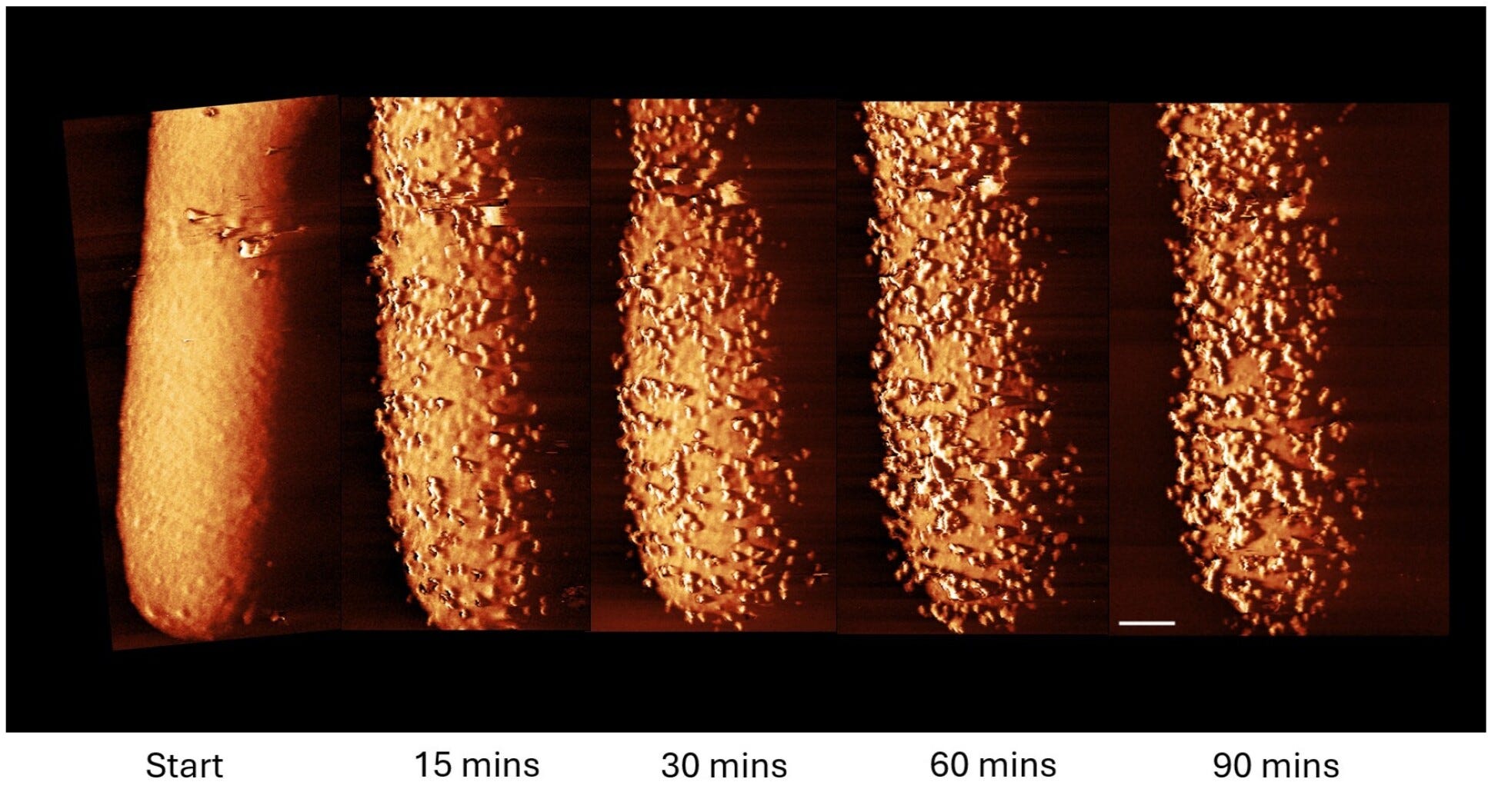
Amazing images show how antibiotics pierce bacterial armour | Imperial News
3-minute read
UK researchers have shown for the first time in stunning detail how life-saving antibiotics act against harmful bacteria.
Osaka Great Peace Tower | Offbeat Japan
1-minute read
The tower’s idiosyncratic design, similar to Gaudí’s architecture, resembles a finger pointing skyward. It was designed by the second Oyasama, Tokuchika Miki. Construction, carried out by the Nikken Sekkei architectural practice, was originally planned in terracotta but eventually a mixture of expanded clay and concrete was used as being more resistant to earthquakes.