Links
3 stars
Why Steve Kerr stayed with the Warriors | ESPN
42-minute read
Wright Thompson with another stellar piece:
Steve Kerr walked into the lobby of the Beverly Wilshire with a secret. Win or lose, he’d decided to retire as head coach of the Golden State Warriors. It was a Tuesday morning in mid-April, the day before the team’s first postseason play-in game in Los Angeles. When this season ended, his 12-year run with the Golden State Warriors would end, too. In the airy hotel restaurant behind the concierge desk, Kerr gave his name and room number, 516 -- “Johnny Bench Joe Montana” -- and a hostess showed us to a table by the window. He looked around and lowered his voice.
“I think it’s over,” he said, almost mouthing the words. His sweatsuit separated him from the businessmen eating breakfast in suits and ties nearby. He put the odds at 95 percent. In the last few days he’d grown more certain. The waiter took his order, the California Breakfast. Normally he’s cheerful as a sunrise but this morning he seemed melancholy. He was tired at the end of a disappointing season and mourning the fraying connections. A great basketball team stands on a shared feeling more than strategy or scouting. The team lives as long as the feeling lives and when it’s gone, not only is it impossible to recapture, it’s hard to even remember.
The waiter brought Kerr’s eggs. Sitting in yet another hotel breakfast room at the end of yet another long season, he sifted through memories. Like the night Klay Thompson scored 37 points in a quarter, his teammates delirious at the sight of it, Steph Curry running up and down the sidelines as the crowd got louder and louder. “It felt like we were in the presence of God,” Steve said, and when I asked why sometimes players reach a flow state, he said it was more than optimized mechanics.
“I think there’s some mysterious spiritual thing.”
The Life and Times of an American Tween | New Yorker
21-minute read
On a Wednesday afternoon, I was joined outside A.P.G. by Mira, a sixth grader with an open, angelic face and an ebullient presence. It is often chilly and overcast in the Outer Sunset, but this was a warm and clear day, and Mira, who is interested in matters of fashion, wore low-slung cargo sweatpants and a white tube top. Her hair, which is long, dark, and curly, had recently been treated to a bathroom Manic Panic job, and the front strands were dyed a light peach. She smoothed a strand as one might the tail of a cat. Mira is good company: frank, funny, and self-deprecating in a way that suggests confidence rather than its lack. At four feet eight, she is small for her age, but manages to occupy space laterally. She moves with a noodle elasticity, and is prone to breaking into dance moves while going about her business: a full-body wave from wrist to wrist, an entire sequence from a Katseye music video. The first time we met, we were mid-conversation when she inexplicably dropped into a side split, grabbed her ankles, and rolled backward, placing her toes on the floor behind her head. “At the beginning of the year, I couldn’t do an aerial”—a hands-free cartwheel—“and I can kind of do one now,” she told me, harrowingly assuming the starting position.
Mira is twelve years old and lives in the Avenues, San Francisco’s foggy western neighborhoods, with her mother, Michalle, who is a nurse practitioner, her father, Patrick, who is a full-time parent, and her sibling, Dylan, who is nine. (Last year, Dylan requested to use they/them pronouns, which the family mostly remembers to honor.) Like most kids her age, Mira exists in the murky, thrilling bardo between childhood and maturity. She is a gracious host—quick to offer guests a Spindrift—who totes a lunchbox adorned with a sticker of a unicorn. She is learning to cook, mostly quesadillas, but if she could she would live on Cheetos, boba, Trü Früs, and Coke. She razzes her parents in a way that makes them laugh, but no longer tells them everything. Mira’s first middle-school dance was coming up, and there was discussion among her friends about dresses and hair styles. I was excited to see which of her dance moves would make an appearance.
For years, Mira has been agitating for more independence. Last August, she began commuting to and from school alone, hurtling around the edge of the continent on the public bus. Since fifth grade, she has worn a silver Apple Watch, a glorified tracking device, which she pushes to the outer limits of usability. She is a member of several large group chats, including one called “4th Period Baddies,” and regularly consults Siri, summoning facts and images from the ether. (“Photos of hazel eyes.” “What does A.S.M.R. stand for?”) Still, the watch is no phone. A phone would be much cooler; would be, perhaps, the coolest thing. An Apple Watch was a bridge from childhood to adulthood. A phone would be a portal.
Original link | Archive.is link
All My Dad’s Sons | The Paris Review
11-minute read
My dad used to take me to work with him. He worked at a group home for juvenile delinquents. I remember playing on the floor of a windowless office one afternoon—zooming some toy cars around—when the door kicked open and a teenager flew in. The kid smacked hard against the polished tile floor with the weight of two grown men on top of him. They were trying to calm him down, and his face was pink and wet with tears. He was screaming.
I was five years old. I scooted my cars back into a corner and went on playing.
Such scenes were part of my childhood. These were pretty desperate boys, twelve to eighteen years old, ten of them living together on the grounds of an old tuberculosis hospital. I remember a redbrick home with many rooms—what used to be apartments for nurses—way up on a hill, the path to it winding through the trees. Sometimes the new boys—orientation phases—would tear off down the hill on foot and try to make it into town. This was eastern Kentucky in the eighties. Near the home was a highway, a gas station, and a rundown motel where a man had murdered his wife. That was about it.
Dad was pretty good at finding the boys who wanted to be found, but if you stole a car or broke into somebody’s house, he couldn’t take you back. It was a community-relations issue. Two boys stole my mom’s car once and drove it into a ditch, totaling it. Another boy ran off and no one ever heard from him again. He was fourteen years old, but it said in his file he was a prostitute, and everyone was pretty sure that was the life he’d gone back to—that he’d made it down to the highway and caught a ride.
The Global Fertility Crisis Is Worse Than You Probably Think | Derek Thompson
17-minute read
Everybody knows about the decline in birthrates. Fewer people understand why—or just how significantly it could transform society in the next few decades.
Why has the number of births declined everywhere, all at once?
This was the subject of last week’s Plain English episode and a new blockbuster report from the Financial Times’s John Burn-Murdoch. In fact it feels like just about everybody has been taking a crack at this question recently.
Some blame it on technology. One week ago, my feed was flooded with a viral video of Connor Leahy, an AI researcher, speaking about the sterilizing effects of modern technology. Among his friends, “no one’s having kids,” said Leahy, who was 30 at the time. “Do you know how hard you need to abuse a mammal to make them not have children?” If you asked Leahy what the explanation was, “my answer is technology,” he said. “My answer is social media. My answer is AI.”
Others blame a kind of 21st century weltschmerz—a world sadness about the state of the world and our uncertain future in it. A long essay in the New York Times by Anna Louie Sussman, entitled “Why So Few Babies? We Might Have Overlooked the Biggest Reason of All,” an excerpt from her forthcoming book Inconceivable, argued that we have “overlooked” the pervasive sense of existential uncertainty among young adults. Between climate change, rising housing costs, political instability, AI, inflation chaos, doomscrolling, and declining social trust, today’s generation is too anxious about the future to make the irreversible commitment of having a child.
So who is right? Is this about phones and technology, or is it a reflection of modern anxiety about the world? Or, perhaps, both?
‘You are always just a kiss away from me my beautiful boy.’ Their family members vanished near Mass. Ave. They won’t stop searching. | Boston Globe
13-minute read
Jan Hogan remembers a moment from more than 20 years ago, when her son was in the hospital. The accident had been horrible: the car had plowed through a telephone pole, and Bryan — her sweet, strong-willed 18-year-old — was thrown through the windshield.
The nurses put him on a morphine drip, and as he lay there, after it finished, he kept pushing the button for more, like it was a tic. “It’s all done, Bry,” Jan told him. “It’s out.”
He just found the motion comforting, he told her. Even back then, it made her uneasy.
It’s now been more than four years since Jan and her husband, Chris, last saw their son. He was standing there glassy-eyed in their rearview mirror as they pulled out of a parking lot near a methadone clinic in Brockton. Jan still hates thinking about the look in his eyes. “There was no there there.”
And the previous few months had been so good: Bryan was sober and happy and helping around the house in Wareham. He went kayaking with his sister. They went to a family wedding. He had a job at the package store down the street.
Then they caught him using again. Jan had walked into his room just after midnight to find him hanging half off the bed, crack paraphernalia scattered around him. “This is bigger than us again,” Jan told him.
Original link | Archive.is link
2 stars
Strangers Rent My Home, Sleep in My Bed, Play My Guitar | The Dial
10-minute read
I felt sad for weeks in anticipation. The fridge, the bedroom, the bathroom were taken care of slowly, one minor shift or disappearance at a time, as we prepared for the guests’ arrival. They had booked our apartment in Rome for five nights on a platform that allows you to stay in another person’s home — either through a direct home swap, or indirectly by way of a credits system that allows you to book a home at a later date. No money is ever exchanged. The platform says we are 250,000+ members in 155 countries. It promotes a global community “built on trust.”
[...]
What does it mean to be middle class? I’ve never needed to wonder before. But now that we have been making the same amount of money over the past decade (wages are stagnant in Italy) and the cost of living has almost doubled, our privileges can’t keep us from asking where this erosion is taking us, and what things like renting out your bed for extra money or traveling credits might mean.
I only really started to think about the middle class, of course, when I felt I was sort of losing my grip on it. Being middle class is the expectation that you’ll be granted some level of work, safety, the means to manage your health, rest. A home where you can entertain guests. It is the humble awareness that these markers are bound to change over time. The lifestyle is always the same, but it comes in different hues — from drab to sparkling. (It is ironic that our world’s most iconic board game is named after the principle causing the actual destruction of the middle class: Monopoly.) As we play society’s game, we keep calm and carry on.
He’s So Random | The Atlantic
7-minute read
Max Hawkins had started to feel trapped by his optimized life. Every weekday, he woke up at exactly 7 a.m. and grabbed a single-origin pour-over from the best café in his San Francisco neighborhood, at least according to Yelp. He got on his bike and rode 15 minutes and 37 seconds along the best possible route to Google, where he was a software engineer. He spent eight hours working, then met friends for a beer at a craft brewery or a hang in Mission Dolores Park. But despite his great job and charmed life, something felt off.
One afternoon at work, while reading an academic paper, he located the source of his ennui. The study, which tracked the movements of 100,000 anonymized mobile-phone users over six months, had found that human mobility is surprisingly predictable: Our days default to simple, repeatable patterns.
The engineer part of Max’s brain thought the research was pretty cool, but he also found it unsettling. “There was something very programmed about the way I was living,” he told me. If his movements were that predictable, where did that leave his free will?
[...]
In 2015, Max left his job at Google and went all in on randomized living. He gave up his apartment in San Francisco and wrote an algorithm to recommend different places to live around the world within his budget. He figured he would live one to two months in each place, before packing up and rolling the proverbial dice once more. His first move was to Ho Chi Minh City, Vietnam, on a one-way ticket. He would maintain a nomadic lifestyle for more than two years.
Original link | Archive.is link
Dopamine TV | The Dial
7-minute read
On any given day in China, roughly 215 million people spend over an hour watching short dramas. These dramas have multiplied on China’s internet, with 33,000 released in 2025. It’s a more than 100-billion-yuan ($13.8 billion) market domestically, double what it was in 2024.
Almost everyone I know has watched at least one. Most people will find snippets on social media platforms like Douyin and RedNote, and become engrossed, then download dedicated app like ByteDance-owned Hongguo and Fanqie Short Dramas which offer a free-to-watch with ads model. For other apps like Maimeng, they buy a membership to unlock episodes.
[...]
By 2020, web novels were already a 25-billion-yuan market ($7 billion). These stories were often tailored in real-time to reader feedback. They operated on a serialization model, where a reader could expect several new chapters each day. Short dramas tapped into these stories of time travel, revenge, and high fantasy — and translated the narrative patterns of web novels into video.
Maybe Your Friends Are Why You’re Not Having Kids | Rob Henderson’s Newsletter
4-minute read
The researchers asked respondents how many kids their three closest friends had, and how those friends would react if the respondent had another baby. Would they offer to help? Cook meals after the birth? Or would they worry about their career stalling or stop inviting them out?
The answers were associated, to a startling degree, with the desire to have children. For Americans under 30 with the least supportive friends, desired family size was about 1.7 children. For those with the most supportive friends, it was 2.8. That is a full extra child, associated with nothing more than having trusted friends who show up.
I have never been working class | Noahpinion
8-minute read
I grew up in the 1980s in a small house with only one bathroom shared between four people. The floor was linoleum. There was a carport instead of a garage, and we had one beat-up used Toyota Tercel hatchback. I don’t remember when we got our first color TV, but when I was young we had a black-and-white one that my grandmother gave us. Our furniture was all second-hand and we kept the couches covered up with worn old blankets.
When I was young, I mowed lawns for money. As a high school kid, I signed up to pick cotton by hand (!!) for an agricultural research project at Texas A&M University, for minimum wage1. I have also worked as a cashier. Twice in my life, I have been a member of a labor union, and I have marched in a strike.
I have never once considered myself part of the working class.
Why not? Because I have never thought of class as being defined by a present snapshot of someone’s lifestyle or material circumstances. Instead, I always thought of class as being about someone’s potential. And I grew up always knowing that my economic potential went far beyond the rather humble circumstances of my early childhood.
1 star
Neanderthals and modern humans may have shared culture 59,000 years ago in Turkey, study finds | Live Science
3-minute read
Deep in a limestone cave on Turkey’s Mediterranean coast, archaeologists have uncovered evidence that Neanderthals and the modern humans who moved in later left behind surprisingly similar traces of their daily lives — evidence that they hunted the same animals, crafted the same stone tools and collected the same type of seashells.
The findings, published Monday (July 6) in the journal PNAS, feed into some of the biggest questions in human evolution: How similar were the cultures of Neanderthals and Homo sapiens, given that we’re so closely related? And did we share information with one another?
[...]
“Our findings indicate a deep level of cultural interaction,” study co-author Naoki Morimoto, paleoanthropologist at Kyoto University, said in a statement. “These two distinct but closely related human groups were not just adapting to the same environment: they were probably sharing symbolic preferences.”
The secret of human intelligence may lie in the power of a single brain cell | Medical Xpress
2-minute read
Researchers found that neurons in the human cortex are significantly more complex information-processing units (”microchips”) than those of other mammals. The findings suggest that the building blocks of the human cortex may themselves be uniquely powerful, offering a possible explanation for how humans developed such exceptional cognitive abilities.
[...]
The results show that human cortical neurons have a remarkable computational advantage. Thanks to their richly branching dendritic trees and distinctive electrical properties, these cells can perform surprisingly complex computations on incoming information, such as visual input (e.g., distinguishing between images of cats versus dogs).
This means that a single human cortical neuron is not just a simple “on–off” building block in the brain; it is already a sophisticated computing unit in its own right, with computational capabilities equivalent to those of a deep neural network.
Venetian Bridge Brawls in 17th and 18th Century Art | The Public Domain Review
2-minute read
Before crowds jostled for biennale parties and gondola rides, Venice’s waterways witnessed scenes of an even more violent kind — “La Serenissima” this was not. Factional divides ran deep, and were frequently expressed (if not settled) in street combat. Even Venice’s origin myth was partisan: the archipelago is said to have been founded by the genta da terra (from Byzantine Heraclea) and the gente da mar (from the Venetian Lagoon). The earliest reports of stick battles between the two groups date to soon after their supposed arrival around the year 800. By the Renaissance period, working-class Venetians’ loyalties were, if anything, more entrenched. The Castellani faction, known also as the “red shrimps”, was largely made up of shipbuilders from Venice’s east. The core of the Nicolotti, or the “shadows”, were fishermen from the west. When they clashed in the streets to fight for the possession of a bridge — as they did often, on Sundays and holidays — the Castellani and Nicolotti showed their partisan loyalties with red and black clothing and fighting caps.
The battagliole sui ponti, or “little battles on the bridges”, ranged from boxing matches to mid-sized brawls to “enormous, prearranged wars . . . battled out for hours before tens of thousands of spectators”, writes historian Robert C. Davis. These boisterous, violent clashes were part of a long history of Venetian civilian battles, staged around (and sometimes spilling into) the city’s winding waterways. Fists and cudgels were the primary weapons — hence the name guerre dei pugni, or wars of the fists — though agitators threw stones and drew daggers. Men and boys were often injured as they sparred for control of one or another of Venice’s several hundred bridges. Sometimes they were killed. Each fight crowned new popular champions, spawned new slights and new battle stories, and fueled the next canal-side fistfight’s contrivance.
Japan’s Tourism Troubles Are Being Fuelled By Social Media Assholes | Aftermath
5-minute read
I just got back from spending two weeks in Japan, and if there’s one thing that defined the trip (other than having a very good time) it was the constant awareness of the country’s growing overtourism problem, coupled with the nagging guilt that I was observing it while also... contributing to it.
[...]
The Japan I visited in 2026 is a very different place. Over the last decade Japan has courted tourist dollars to help prop up a flagging economy, helped slash the cost of flying into the country and in the lead-up to the Tokyo Olympics added a ton more English-language support to its train and subway networks. While sadly those Olympics tourists were never able to make it, the work has nevertheless paid off in the long run: in 2025 Japan attracted over 40 million visitors, a new record.
[...]
The last time I was at Shibuya Crossing, in 2014, I crossed the street, went upstairs to have a coffee at the Starbucks overlooking the landmark and spent a nice, quiet 20 minutes watching the ebb and flow of commuters. In 2026 you couldn’t move without hitting a Westerner filming themselves for some kind of content, their cameras raised above them while they narrated the event (whether there was actually an audience I’ll never know), each one an oblivious centre of their own universe while the 1000 people around them were just trying to get past them so they could cross the road and get home.
Why is almost everyone right-handed? The answer may lie in how we learned to walk | Oxford University
2-minute read
Humans are the only primates with a population-wide hand preference. A new Oxford-led study, ‘Bipedalism and brain expansion explain human handedness’, published in PLOS Biology, traces it back to bipedalism and brain expansion.
It is one of the strangest puzzles in human evolution. About 90% of people across every human culture favour their right hand - with no other primate species showing a population-level preference on this scale. Despite decades of research into the brains, genes and development behind handedness, why humans ended up so overwhelmingly right-handed has remained an evolutionary enigma.
Now, new research led by the University of Oxford, published in PLOS Biology, suggests the answer comes down to two defining features of human evolution - walking on two legs, and the dramatic expansion of the human brain.
[...]
The findings point to a two-stage story. Walking upright came first, freeing the hands from the work of locomotion and creating new selective pressure for fine, lateralised manual behaviours. Larger brains came later, and as they grew and reorganised, the rightward bias hardened into the near-universal pattern seen today.
Anthropic says Claude has carved out its own space to ponder | Axios
1-minute read
Anthropic said Monday that it has identified a small internal workspace Claude uses to hold and manipulate ideas without putting them into words—a structure the company says bears intriguing similarities to how humans consciously access thoughts.
Original link | Archive.is link
A 3,000-Year-Old Painter’s Palette from Ancient Egypt, with Traces of the Original Colors Still In It | Open Culture
3-minute read
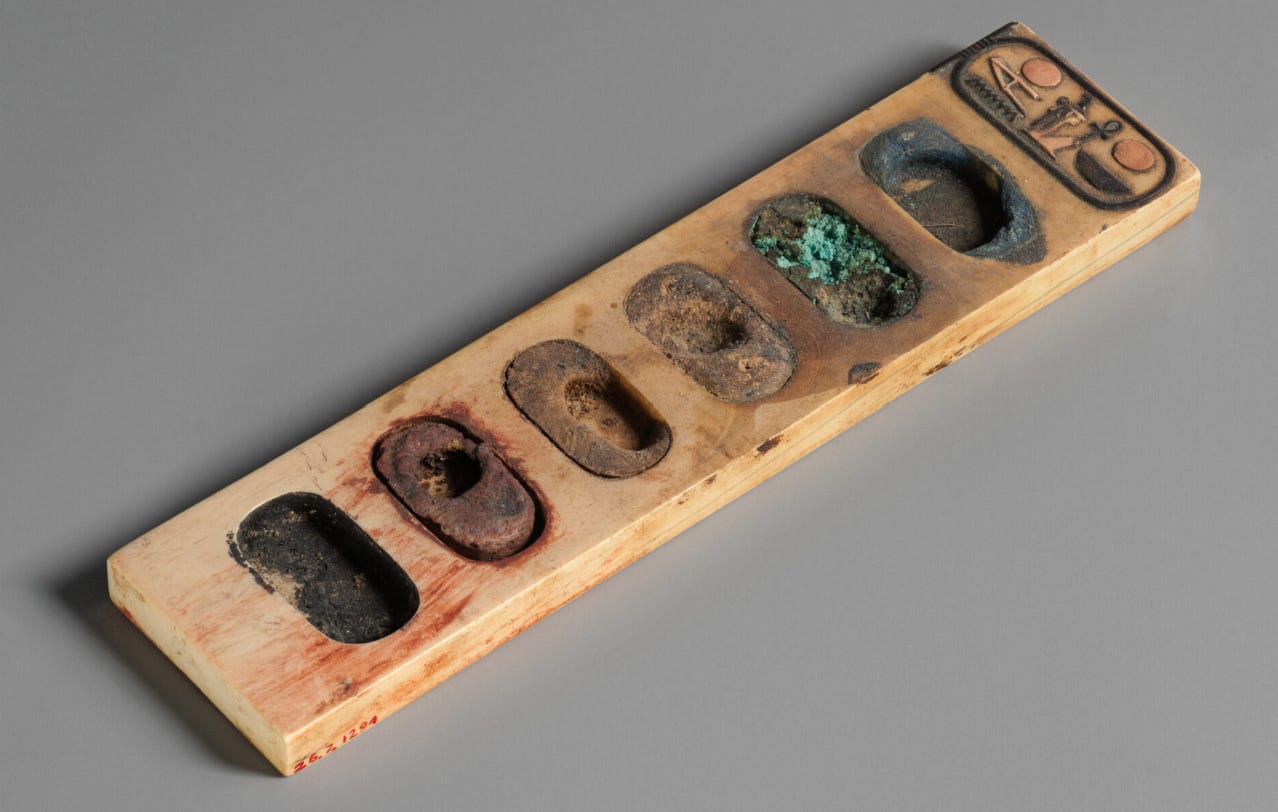
It’s a good bet that your first box of crayons or watercolors was a simple affair of six or so colors… just like the palette belonging to Amenemopet, vizier to Pharaoh Amenhotep III (c.1391 — c.1354 BC), a pleasure-loving patron of the arts whose rule coincided with a period of great prosperity.
Amenemopet’s well-used artist’s palette, above, resides in the Egyptian wing of New York City’s Metropolitan Museum of Art.
Over 3000 years old and carved from a single piece of ivory, the palette is marked “beloved of Re,” a royal reference to the sun god dear to both Amenhotep III and Akhenaton, his son and successor, whose worship of Re resembled monotheism.
This Simple White Line Is America’s Greatest Unsung Innovation | Wall Street Journal
2-minute read
You know about the lightbulb and the iPhone. This is the unknown story of another ingenious creation that changed a nation.